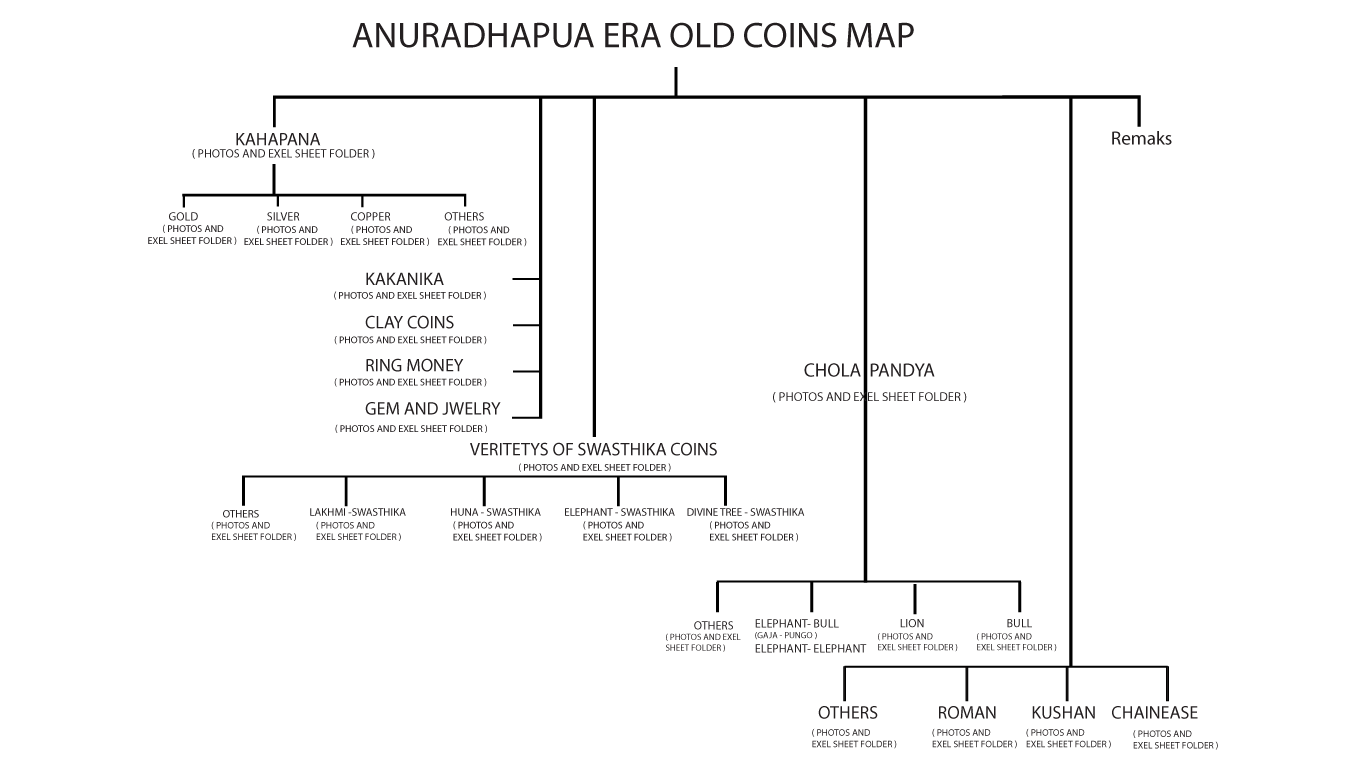
Anuradhapura Era Coins Collection
Currency and Nature of Trade in ancient Ceylon before Vijaya's Conquest of Serendip(Serendhepa)
Although historical records are limited about the economic system of Sri Lanka before Vijaya's conquest of Lanka (before the 6th century BC), a general picture can be drawn from archaeological evidence and the study of cultures in surrounding areas.
Currency
Barter System
Early communities mainly used the barter system.
Natural products such as grains, fish, pearls, and gems were used as mediums of exchange.
Small pieces of metal, bones, shells, special stone pieces, clay balls, and pellets ( laṁjā pōdhiti ) may have been used as mediums of exchange.
Early Forms of Money
Seashells may have been a major medium of exchange.
Essential goods such as salt, pearls
Small pieces of gold and silver
Nature of Trade
Internal Trade
Exchange of grain between agricultural communities.
Trade between fishing communities and agriculturalists.
Exchange of paddy products between the Clove communities
Exchange of handicrafts
External Trade
Trade relations with South India
Ceylon as a hub of the Indian Ocean trade routes
Export of local products such as pearls, jewellery, coal, sandalwood
Import of metal materials, textiles, vessels
Market Places
Port cities (on the south and west coasts)
Trading centres between villages
Trading centres at the mouths of major rivers
The economy of Sri Lanka during this period was mainly based on self-sufficient agricultural communities, and it appears that there was a mixed economy with limited trading activities.
Vijaya's Conquest of Various Native Peoples
Vijay - Yakshas - Naga nation - Kuveni (Kuvanna)
According to the traditional story mentioned in the Mahavamsa, after King Vijaya defeated the Yakshas and expelled them from the island, the following happened to the other indigenous groups:
Naga Nation
As mentioned in the Mahavamsa, when Vijaya and his party landed in this country, the Yaksha nation was mainly living in this country. Regarding the Naga nation, the Sattva chapter of the Mahavamsa states that they gradually merged with the Sinhalese people of the Arya nation. It is said that the Naga nation completely mixed with the Sinhalese people and merged.
Raksha Nation
Although specific details about the Raksha nation are limited, it is stated that they also previously lived in this country along with the Yakshas, and after Vijaya's arrival, they also mixed with the Sinhalese Arya people.
Fate of Nation
Queen Kuveni bore King Vijaya two children. When King Vijaya asked Kuveniya to leave the palace with her two children, she fled with her children and was killed by her Yakka relatives for betraying her.
King Vijaya – Pandukabhaya – Mutasiva: Money and Trade in Sri Lanka
The Monetary System of Ancient Sri Lanka
(Kahapana, Padamasagara, Veleda)
A description of the monetary and trade systems used in Sri Lanka from the time of King Vijaya to King Pandukabhaya and Mutasiva is as follows:
Monetary System
Primitive Period (Vijaya – Pandukabhaya)
Information regarding the use of money in ancient Sri Lanka can be found in various historical, religious, cultural and archaeological sources, but it is uncertain when and where its exact origin occurred.
Main Methods Used
Barter System: Humans were the first to start the Barter System
Commodity Currency: Rice, other grains, micro-organisms, gold, silver, copper were used as currency
Indian Influence: It is believed that the influence of Indian traders was widely used in the trade activities related to ancient money in this country.
Trade
Domestic Trade
Trade based on agricultural products
Exchange of grains, rice, and jewelry
Trade in handicrafts
International Trade
Main trade relations with India
Export of gems, pearls, jewelry
Import of textiles, metal products
Economic Changes During the Pandukabhaya Era
King Pandukabhaya was the first king to unite Sri Lanka. During his time:
Creation of the kingdom of Anuradhapura
Ruled the kingdom for seventy years in the beautiful Anuradhapura, flourishing with all the comforts
Organization of trade routes
Establishment of the judicial system
Time of King Mutasiva
A prince named Mutasiva, born to King Pandukabhaya from the womb of Swarnapali, became king after the death of King Pandukabhaya.
During his time:
Mahamevna Garden in Anuradhapura
Promotion of trade due to urban development
More formalization of established monetary systems
General Characteristics
Monetary units: Use of units such as kahapana, masaka, krama
Trade centers: Major trading cities such as Anuradhapura, Thambapanni
International relations: Trade relations with South India, Bengal
Caste system: 4 types of castes are described. King, Brahmin, merchant and farmer
The merchant caste played an important role in the monetary system.
Money and trade systems during this time were the foundation of the economic base of modern Sri Lanka, and were also a means of building relations with other parts of the Indian subcontinent.